


Mintech Tooling
Cyclone Dust Collector CC2000
Cyclone Dust Collector CC2000
SKU: SKU:RD1001
+ Free Shipping
Couldn't load pickup availability
Share


- Description
- Review
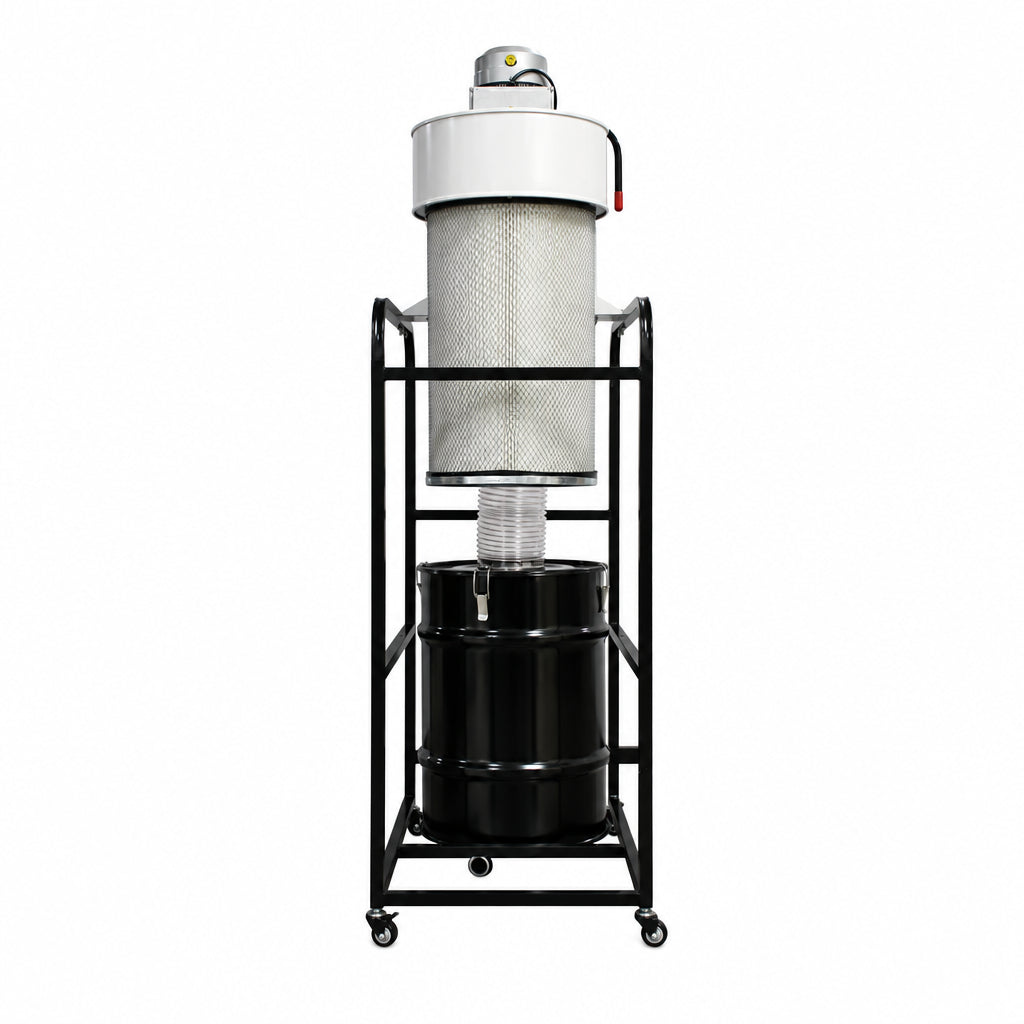
The Cyclone Dust Collector CC2000 delivers industrial-grade air filtration for woodworking shops, metalworking facilities, and manufacturing environments. Powered by a 2.2KW motor operating at 2800 RPM, this unit achieves impressive airflow capacity of 2000m³/h (1000 CFM), efficiently capturing dust and debris at the source. Engineered for single-phase 208-240V operation, it integrates seamlessly into standard workshop electrical systems. The Cyclone Dust Collector CC2000 design separates particulates effectively, extending filter life and reducing maintenance downtime. Ideal for professionals demanding reliable dust control and improved air quality.
1. Mechanical & Structural Engineering
-
Cyclone Body Geometry: Industrial cyclone collectors in the 1000 CFM class typically use a long‑cone, high‑efficiency cyclone with a cone angle between 10°–17°, optimized for:
- High centrifugal separation
- Reduced re‑entrainment of fine dust
- Stable vortex formation at 2800 RPM blower speed
-
Construction Material:
- 2–3 mm thick steel sheet for cyclone walls
- Powder‑coated exterior for corrosion resistance
- Reinforced inlet collar to prevent deformation under high static pressure
-
Impeller Engineering: With a 2.2 kW / 2800 RPM motor, the impeller is almost certainly:
- 12–14 inch diameter
- Backward‑inclined steel blades
- Dynamically balanced for low vibration This configuration supports high static pressure, needed for CNC routers with long duct runs.
2. Airflow & Pressure Performance
- Rated Airflow: 2000 m³/h (1000 CFM)
-
Expected Static Pressure Curve: For a 3 HP cyclone system:
- 10–12 inH₂O at open flow
- 6–8 inH₂O at typical CNC router load
-
4–6 inH₂O at multi‑tool manifold load This allows stable suction even with:
- 4" or 6" ducting
- Multiple elbows
- Long runs up to 25–40 ft
- Air Velocity at Inlet: With 1000 CFM through a 6" duct: Ideal for chip transport and preventing duct clogging.
3. Cyclone Separation Efficiency
Based on typical cyclone geometry and airflow class:
- Coarse Chip Separation: >95%
- Medium Dust (30–10 microns): 80–90%
- Fine Dust (<10 microns): 60–80%
4. Filtration System (Engineering Context)
The page does not list micron rating, but CC2000‑class systems typically include:
-
Primary Cartridge Filter:
- 1–5 micron filtration
- Pleated media with 30–60 sq ft surface area
- Internal cleaning mechanism (manual paddle or air pulse)
-
Secondary Safety Filter (optional):
- Captures ultra‑fine particles
- Protects motor and exhaust stream
5. Motor & Electrical System
- Motor Power: 2.2 kW (≈3 HP)
- Motor Speed: 2800 RPM
- Voltage: Single‑phase 208–240V
Engineering implications:
- Suitable for standard U.S. workshop circuits
- Startup surge may require 25–30A breaker
- Direct‑drive blower eliminates belt maintenance
6. Noise & Vibration Characteristics
Typical for 3 HP cyclone systems:
- Noise Level: 78–85 dB(A) at 1 meter
- Vibration: Minimal due to balanced impeller
- Recommended Installation:
-
- Rubber isolation mounts
- Flexible inlet coupling
- Wall or floor anchoring to reduce resonance
7. Dust Collection Drum & Disposal
While the page does not specify drum size, CC2000‑class units typically use:
- 40–55 gallon steel drum
- Quick‑release latch system
- Clear viewing window or fill indicator
- Gasketed lid to maintain cyclone vacuum integrity
8. CNC Router Integration
The page indicates suitability for CNC routers and manufacturing environments.
Engineering compatibility includes:
- 4" or 6" dust shoe ports
-
High‑velocity chip extraction for:
- Wood
- Plastics
- Aluminum
- Composites
- Stable suction for multi‑pass machining
-
Reduced airborne dust protecting:
- Linear rails
- Ball screws
- Servo motors
- Laser optics (if used near CO₂ systems)
9. Operational Advantages
Based on page claims of “reliable dust control” and “improved air quality. "
Technical benefits:
- Maintains consistent CFM under load
- Reduces filter clogging
- Improves shop air quality
- Extends tooling life by reducing abrasive dust
- Enhances operator visibility during machining
- Supports continuous‑duty production environments